

From Friction to Flow-Redesigning a Computer Vision Pipeline Management Tool
30% Faster Pipeline Creation | 65% Fewer Errors | 6/7 User Satisfaction

My Role
Product Design Intern
Team
1 Product Manager
1 Developer
1 Product Designer (me)
Skills
Visual Design
UX Design
User Research
Prototyping
Usability Testing
Timeline
6 Weeks
Project Overview
CONTEXT
WoPipe is the backbone of Wobot.ai’s computer vision operations, used internally by engineers to create and configure vision-processing pipelines for their AI models. It allows engineers to visually build sequences of tasks that camera feeds into actionable insights, supporting operations like tracking and analytics.
THE CHALLENGE
The original interface was developed by an engineer with no UX foundations, resulting in inconsistent workflows and usability challenges: veteran users worked around it, and newcomers were overwhelmed, directly impacting the speed and quality of AI-driven video analytics delivered to clients.
GOAL
Create a consistent, intuitive UI that:
-
Enables faster task completion,
-
Improves learnability for new users,
-
Reduces errors and improves usability.
Problem
When we started this project, it was already clear that the computer vision team was frustrated with the existing Wopipe tool. The interface was outdated, functionally and visually, more of a workaround than a solution.
-
Inconsistent workflows slowed even experienced users
-
Confusing navigation and modal dialogues
-
No real-time feedback on errors
-
New users made frequent mistakes
1. Visual Hierarchy:
Everything is a grey box. In a crisis, an engineer can't distinguish a "sink" from a "check" at a glance
2. Spatial Efficiency:
The sidebar takes up 25% of the screen. Engineers often work on massive pipelines and need every pixel of that canvas.
3. Affordances:
Are the buttons in the sidebar draggables? Or do I click them? The UI doesn't "tell" the user how to interact with it.

For a technical staging environment, it gets the job done, but it lacks the polish and hierarchy needed to prevent user fatigue.
-
The dropdown list for sample templates is a mess of underscores and version numbers.
-
The playback controls (Play, Stop, etc.) are at the top, while the Zoom/Pan controls are at the bottom left. This forces the user's eyes to jump across the entire screen to manage the workspace.

For a technical staging environment, it gets the job done, but it lacks the polish and hierarchy needed to prevent user fatigue.
-
Modals use blue sliders for thresholds. While visual, engineers often need to enter an exact numerical value.
-
TicketInfo: This modal is a flat list of over 10 input fields with no logical clustering. For a busy engineer, this makes scanning for a specific variable difficult.
-
Modals show, a generic "Network issue or try again adding source block to your pipeline" message. It doesn't pinpoint which node in the pipeline is failing.
-
The blue progress-style bars don't clearly show if they are loading data or representing a set threshold.


User Feedback
Through workflow observation, interviews and feedback we understood a few common user frustrations


.png)


.png)

THE JOURNEY: UNCOVERING HIDDEN PAIN POINTS
Initially, to understand how the tool works and get an idea of what's wrong, I was given access to wopipe. But within hours, I had my first crucial realization, and this moment of humility changed everything.
"I soon realized that you are not your user"
TAKING INITIATIVE
I approached my PM with a bold request—let me talk to the actual users, not just analyze the interface. Despite tight timelines, I advocated for this research, knowing that assumptions could lead us down the wrong path.
This was "the moment" to use all the theoretical knowledge I gathered..:)
User Interviews
I spoke with both veteran and new users to uncover hidden pain points and fresh frustrations.
Workflow Observation
Watched users navigate the system in real-time, documenting every hesitation and workaround
Rapid Prototyping
I moved quickly from sketches to wireframes, sharing early ideas with the team for feedback.
INSIGHTS FROM USERS
"Experienced users had developed workarounds for confusing flows but still lost time."
"Everyone wanted more consistency and clearer navigation."
"New users felt overwhelmed and made frequent mistakes, especially with finding components, taking key actions and clunky modal dialogs added unneccesary cognitive overload."
"No Real-Time Feedback on errors."
MY APPROACH
As the sole designer on this project, I was responsible for the end-to-end redesign. I collaborated closely with the developer, the CV team, and my PM.
Understand > Observe > Design > Test > Iterate
LEARNING FROM A FAILURE
I dove into my first iteration with confidence.
My approach seemed logical based on the feedback I got
But...
I underestimated how attached veteran users were to the old workflow. Change, even positive change, requires careful consideration of existing mental models.
THE BREAKTHROUGH: DESIGN SOLUTIONS
Simplified Navigation System & Modern UI
The Problem: Users clicked through 5-7 screens to complete basic pipeline creation tasks
The Solution: Flat, guided sidebar navigation with logical grouping and clear visual hierarchy
The Validation: Task completion paths reduced from 7 clicks to 3, with 85% of users finding features on first attempt
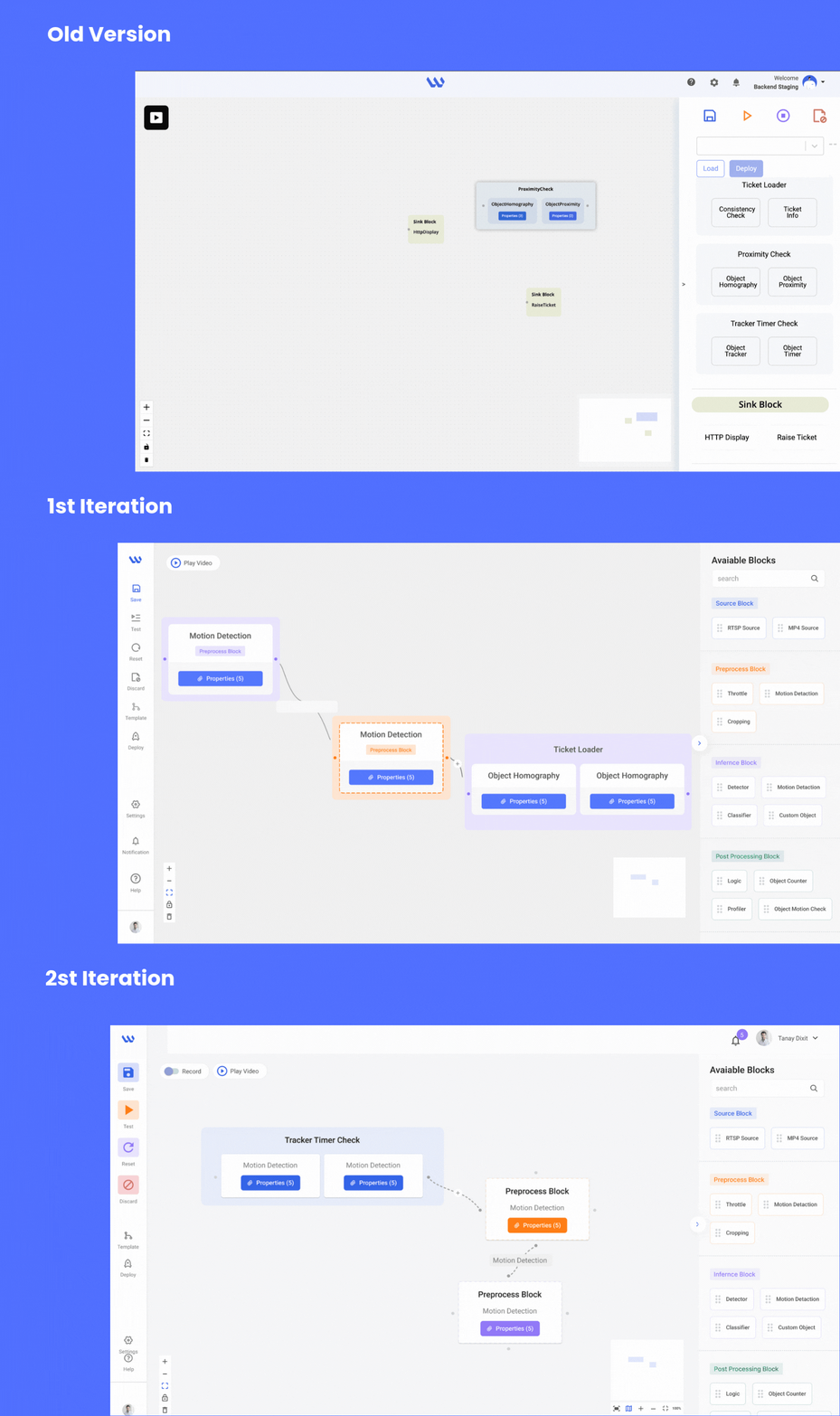
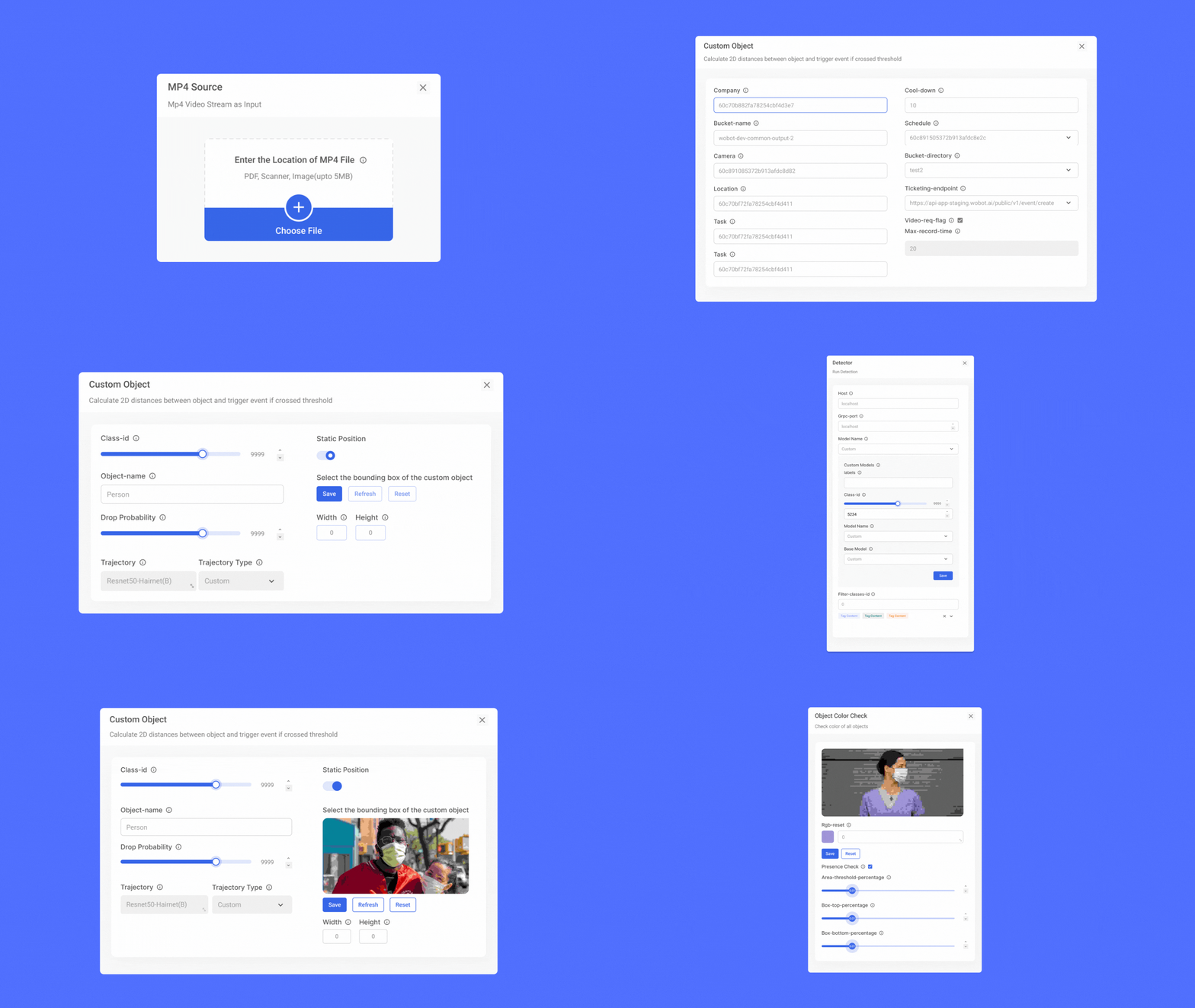
Standardized Modal System
(20+ Modules)
The Problem: Each modal had different layouts, button placements, and interaction patterns
The Solution: Unified design system with consistent typography, spacing, and feedback mechanisms
The Validation: Modal-related errors dropped 40% in testing, with users expressing increased confidence in their actions
MY FIRST WIN!!
-
New users completed core tasks 25% faster than with the old interface
-
Combined user groups: 30% reduction in pipeline creation time
-
Veteran users adapted quickly to the new interface thanks to familiar icons and interaction patterns that maintained continuity with their existing workflows.
-
40% decrease in modal-related mistakes
-
95% of testers preferred the new interface after the second iteration
-
Consistent experience across tools due to standardized components
-
Team productivity boost: Hours previously lost to navigation now redirected to innovation
"I can finally focus on building, not figuring out where things are! This feels like the tool I always wanted WoPipe to be."
- Computer Vision Engineer
BUSINESS IMPACT
-
Reduced support burden on the development team
-
Faster onboarding for new computer vision engineers
-
Improved tool adoption across the organization
-
Foundation for future feature development with consistent design patterns
As an Intern - Product Nikita was actively & diligently devoted to tasks assigned to her. During the span, we found her hardworking. Her learning powers are good, and she picks up swiftly. Her feedback and evaluation proved that she learned keenly. We wish her a bright future.
- Barkha Sharma
Chief Human Resources Officer
Wobot.ai